Penn State graduate students in a research-based degree program are invited to participate in Penn State's annual Three Minute Thesis competition (3MT), hosted by the J. Jeffrey and Ann Marie Fox Graduate School. 3MT helps graduate students improve their research communication and presentation skills, permitting just three minutes and one static presentation slide to effectively communicate their research and its impact to an audience outside their field.
Penn State Great Valley graduate students Venkata Sai Renusree Bandaru and Faizan Raza both said they had to read the emails more than once before it sank in that they had received Penn State’s prestigious Fox Scholar awards, which celebrate graduate students for their exceptional academic achievement, research and professional impact.
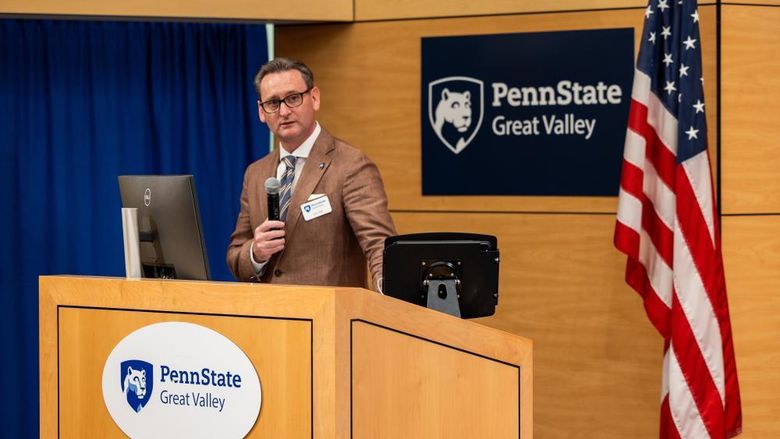
Great Valley Chancellor Colin Neill discussed his experience working with artificial intelligence (AI) in the 1990s and how Great Valley is preparing students and organizations today for the far-reaching changes AI is sparking across industries. Neill also explained why AI often produces mediocre output and how to use it to get exceptional results.
At Penn State Great Valley’s annual student research poster competition, students presented a variety of projects to faculty and guests. The three winning posters focused on a job posting data pipeline for management research, a multi-agent system to automate data science tasks for non-data scientists and reinforcement learning for optimized urban energy harvesting.
The J. Jeffrey and Ann Marie Fox Graduate School at Penn State is now accepting nominations for the second round of Fox Endowment scholarships, created to support graduate students pursuing academic excellence and scholarly impact at the highest levels.
Penn State Great Valley hosted an educational and networking event, “AI in Action: Transforming the Sports Industry” on March 24, featuring a panel of experts, including representatives from the Philadelphia Phillies and Philadelphia Union. They shared how artificial intelligence (AI), data analytics and cutting‑edge technology are changing sports, from elevating player performance to transforming the fan experience.
Thirty-one Penn State graduate students earned awards at the 2026 Graduate Exhibition — the premier annual community showcase for graduate student research, scholarship and creative activity across the University — hosted by the J. Jeffrey and Ann Marie Fox Graduate School on Friday, March 27, on the University Park campus.
Penn State Center for Social Data Analytics and the Consortium on Moral Decision-Making, in collaboration with the Social Science Research Institute, has announced the recipients of their most recent seed grant awards.
Penn State's Center for Socially Responsible Artificial Intelligence has announced the winners of Teach-a-thon, a University-wide challenge for faculty to showcase innovative teaching practices in response to the rapid rise of generative AI.
At Penn State Great Valley’s Industry Engagement Day, leaders from industry and academia explored how they combine their expertise with artificial intelligence (AI) to tackle challenges across diverse sectors. The campus is seeking new collaborations with industry partners who want to consult with expert faculty and students to improve their operations and solve complex business problems.